



What truly defines a West Coast IPA?
West Coast IPAs are back. After a decade where everyone swore by hazy, juicy NEIPAs, this crystal-clear Californian style is resurfacing in bars and breweries. But beyond the trend, what truly defines a West Coast IPA?
It's not just "a clear IPA." It's a beer that makes no apologies. Glass-clear, unapologetically bitter, with bold pine and grapefruit aromas. The exact opposite of the soft, comforting IPAs that were popular for years.
The West Coast IPA is what happens when Californian brewers in the 70s decide that industrial lagers are over. They took American hops, threw them unreservedly into their tanks, and created an aromatic monster that fully embraces its sharp bitterness.
Three pillars that define the West Coast IPA style
A West Coast IPA can be recognized by three non-negotiable characteristics. You don't need a brewing degree to spot them. Just look at the glass, smell, and taste.

Unapologetic crystalline clarity
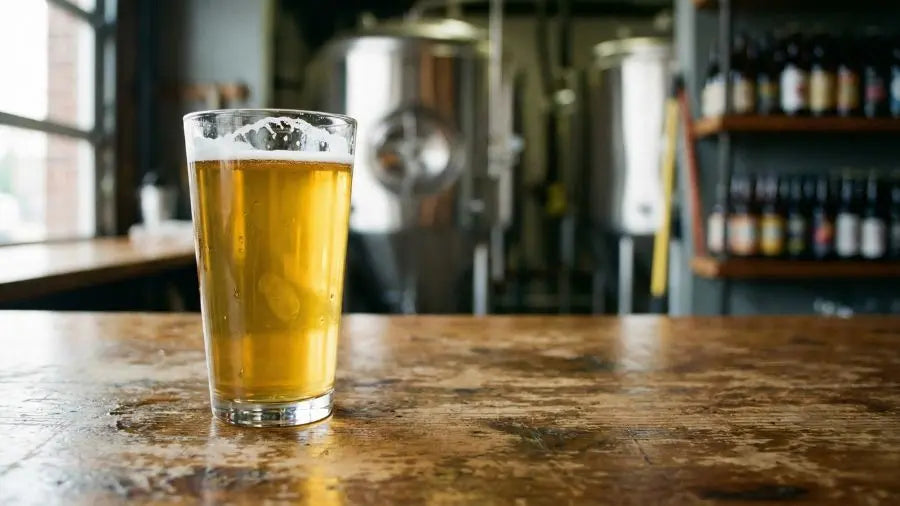
Forget the haze. A West Coast IPA must be clear, bright, and transparent. When you hold your glass up to the light, you should be able to see through it. No veil, no opacity, none of that artistic blur that characterizes NEIPAs.
This clarity comes from a clean fermentation and high attenuation that allows the yeast to settle naturally at the bottom of the tank. West Coast brewers never sought to mask their beer. Quite the opposite. They wanted to show that they mastered their process from start to finish. The color ranges from pale gold to light copper. Never dark, never cloudy. This transparency becomes an immediate visual signature.
Dry bitterness as a signature
Here, we don't mess around. The bitterness of a West Coast IPA hits hard from the first sip and doesn't let go until the last. It's dry, sharp, almost aggressive for those not used to it.
This bitterness results from precise hopping during the boil, which extracts a maximum of alpha-acids. These molecules give that bitter sensation in the mouth. The longer you boil the hops, the more bitterness you extract.
And the finish remains dry. No residual sugar to soften the blow. The malt remains discreet, almost erased. Everything is done to let the hop bitterness dominate from beginning to end. Some find it brutal. Others call it honesty.
Hops in the spotlight with resinous aromas
The nose of a West Coast IPA never lies. As soon as you bring the glass close, you are struck by aromas of pine, resin, and citrus. Grapefruit especially, but also blood orange, lemon.
These aromas come from classic American hops: Cascade, Centennial, Chinook. These varieties give the resinous and citric profile that has defined the style from the beginning. No fruity hops like mango or passion fruit. Here, it's all about pine, resin, citrus. Hops are not just another ingredient. They are the absolute star.
Born in California in the late 70s, popularized in the 90s
The story begins on the American Pacific coast, when a few brewers decided to shake up the brewing landscape. At the time, Americans drank bland, standardized industrial lagers.

In the 70s, pioneers began to experiment. They had access to American hops grown in the Yakima region of Washington State. Varieties that gave completely different aromas from traditional English hops.
Sierra Nevada launched its Pale Ale in 1980. It wasn't yet a West Coast IPA in the strict sense, but it was the gateway. A clear beer, hopped with Cascade, which introduced these pine and citrus aromas to the American public.
The 90s marked the explosion of the style. Stone Brewing, Russian River, Firestone Walker. These Californian breweries pushed the concept even further. More hops, more bitterness, more aromas. The West Coast IPA became a genre in its own right, with its codes and references that remain valid today.
A brewing philosophy where bitter hops reign without compromise
Beyond the technical characteristics, the West Coast IPA embodies an attitude. That of brewers who refuse to compromise on bitterness to please the masses.
Hopping is mainly done during the boil. Unlike NEIPAs, where fruity roundness outweighs bitterness, and cold dry hopping is favored to extract aromas without bitterness, here we are specifically looking for that bitterness. We want the hops to hit hard, for the finish to remain dry and sharp.
This approach is bound to divide. During the 2010s, many drinkers turned to softer, juicier, less aggressive NEIPAs. The West Coast IPA seemed outdated. Too bitter. Too brutal.
But the style is making a strong comeback. Because there is a real demand for beers that embrace their character without trying to please everyone. Refreshing beers despite their power, with a light body that makes them surprisingly easy to drink once you've tamed the bitterness.
The West Coast IPA remains a characterful beer among the great craft beer styles. It doesn't pretend. It hides nothing behind a creamy texture or fruit juice aromas. It tells you exactly what it is from the first sip.
And it is precisely this honesty that continues to appeal to those who seek beers with personality. In contrast, Session IPAs prioritize lightness for a less brutal but equally hopped approach.
Cheers 🍻


